What four years of testing LDHA and DRD4 taught us about breeding marathon pigeons
We hadn’t given much thought to LDHA and DRD4 testing for several years.
Between 2019 and 2022, we tested pigeons within our own loft, deliberately formed breeding pairs around the results and, most importantly, raced the offspring. Eventually, we reached our own conclusions and moved on.
Then, strangely, two things happened within the space of two weeks that made us look back at all those old findings again.
The first was a conversation with our friend Iván.
He asked whether we believed in LDHA and DRD4 and whether we had ever checked the genes of our breeding pigeons. He mentioned that the subject seemed to be attracting plenty of interest amongst Dutch and Romanian marathon specialists.
Our answer was simple.
Yes. We hadn’t just tested it — we had bred according to it.
Then came the second reminder.
While looking through the pedigree of the 2026 Belgian National winner from Narbonne, something immediately caught our attention. Within the breeding was the outstanding Hebberecht cock BE13-4169172 “Lord”, a top Agen racer and superb breeder.
Printed alongside him on the pedigree:
LDHA genotype: AA.

Amir
Seeing those two letters brought the whole subject back.
Because after four years of experimenting ourselves, we had been left with a very different view of genetic testing than when we started.
Not that the science was wrong.
In fact, some of what we discovered made us think there could be something very interesting in it.
But we had become much less convinced that a couple of favourable genetic markers could tell us which pigeons would succeed at our particular job — marathon racing into Britain across the Channel.
⸻
Why LDHA and DRD4 Interested Us
The attraction of genetic testing is easy to understand.
If particular genetic variants occur more frequently amongst successful racing pigeons, surely identifying those genes could give the breeder another tool when selecting future breeding pairs.
And there is genuine research behind the discussion.
LDHA is involved with lactate metabolism, while DRD4 is a dopamine-receptor gene. Various studies have investigated associations between variants of these genes and racing performance. Importantly, though, the scientific picture isn’t as simple as saying one genotype produces champions and another doesn’t.
A 2022 prospective study, for example, found no overall performance difference between LDHA genotypes in the population it studied, although there was a suggestion that AB pigeons performed better at longer distances. It found a significant association involving one DRD4 genotype, with its largest effect appearing in shorter races. The authors themselves concluded that larger studies involving unrelated pigeon families would be needed before identifying any superior genetic profile.
That is remarkably close to where our practical experience eventually took us.
But we didn’t know that when we started.
We wanted to test it ourselves.
⸻
We Bred According to the DNA
From approximately 2019 through 2022, we began testing pigeons and actually using those results when putting breeding pairs together.
This is an important distinction.
We weren’t simply testing a few champions afterwards and looking for interesting letters on a certificate. We tried to use the information prospectively.
We paired pigeons carrying the combinations we believed should give us an advantage and bred youngsters specifically from them.
Then we raced them.
And ultimately, the basket didn’t give us the answer we expected.
The offspring produced from some of the combinations that looked most exciting genetically did not go on to dominate our loft.
We lost pigeons carrying the supposedly desirable combinations.
Meanwhile, pigeons carrying what appeared on paper to be the “lesser” genetic results could regularly arrive ahead of them, particularly from the shorter races.
That didn’t prove that the genes were irrelevant.
But it certainly proved something to us:
We couldn’t use those results alone to identify our best pigeons.
And one of the greatest breeding hens we have ever owned would reinforce that point.
⸻
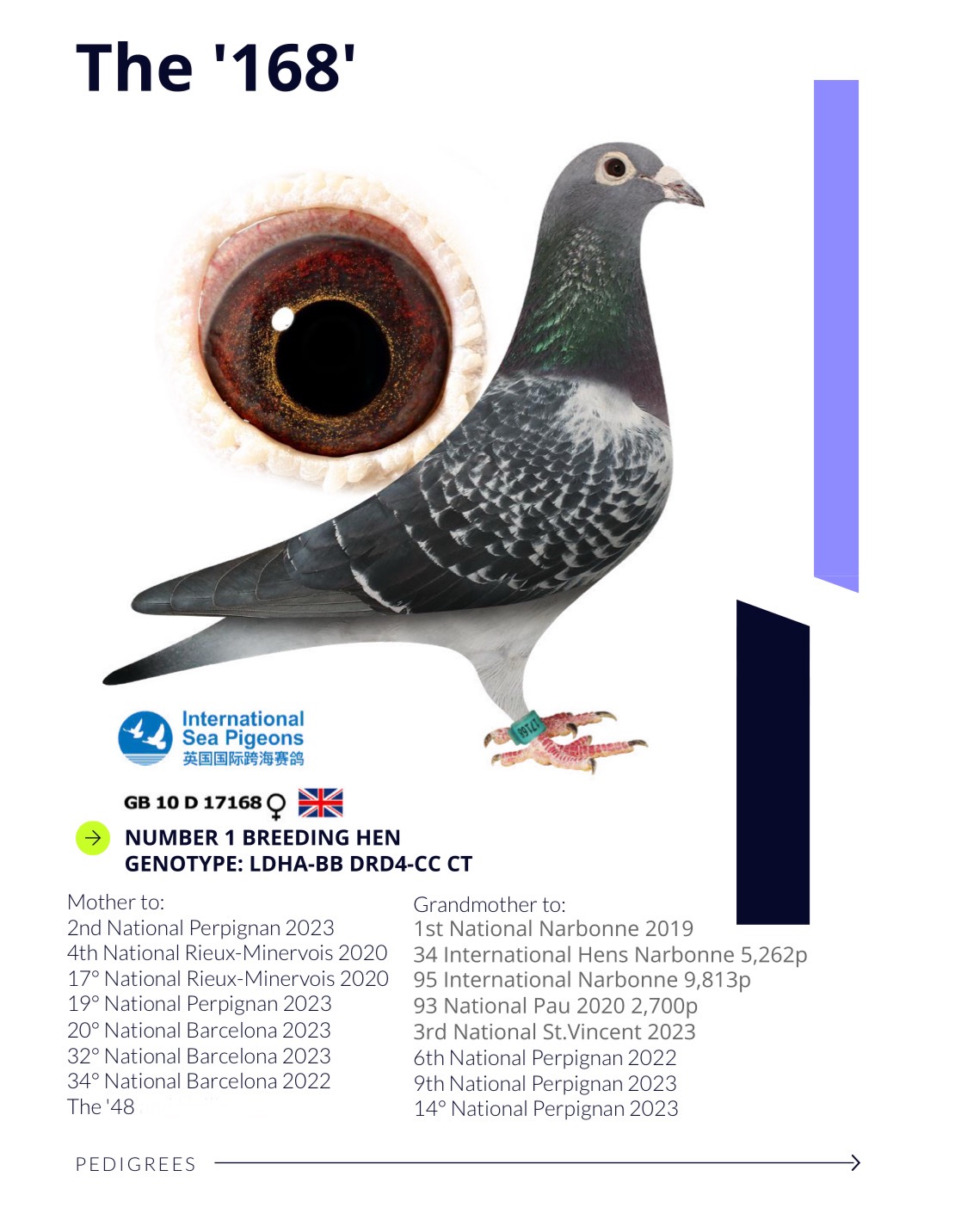
The 168
GB10D17168 — “The 168” — became our No.1 breeding hen.
Her influence on our loft has been enormous.
She became mother to pigeons responsible for performances including:
2nd National Perpignan 2023
4th National Rieux-Minervois 2020
17th National Rieux-Minervois 2020
19th National Perpignan 2023
20th National Barcelona 2023
32nd National Barcelona 2023
34th National Barcelona 2022
Her grandchildren added performances including 1st National Narbonne 2019 – 34th International Hens 5,262p – 95th International 9,813p, 3rd National St Vincent 2023, 6th National Barcelona 2025, 6th National Barcelona 2026, 8th National Barcelona 2026, 6th National Perpignan 2022, 9th National Perpignan 2023 and 14th National Perpignan 2023, 92nd National Pau NFC 2020 2,700p, 30th National St.Allouestre 2023 1,913p, 19th National St.Malo 2023 1,309p and 10th Yearling National Penzance 2023 3,070p.
Her genotype?
LDHA-BB / DRD4-CC CT.
The 168 already had successful Channel blood behind her, and throughout her breeding career we repeatedly paired her back into other families that had demonstrated their ability on the routes we wanted to race.
That distinction became increasingly important.
We weren’t simply trying to breed CT to a particular genotype and expecting the letters to produce a champion.
We were putting proven Channel blood back into proven Channel blood.
And the results kept coming.
⸻
Then Came Rezenthel Frères
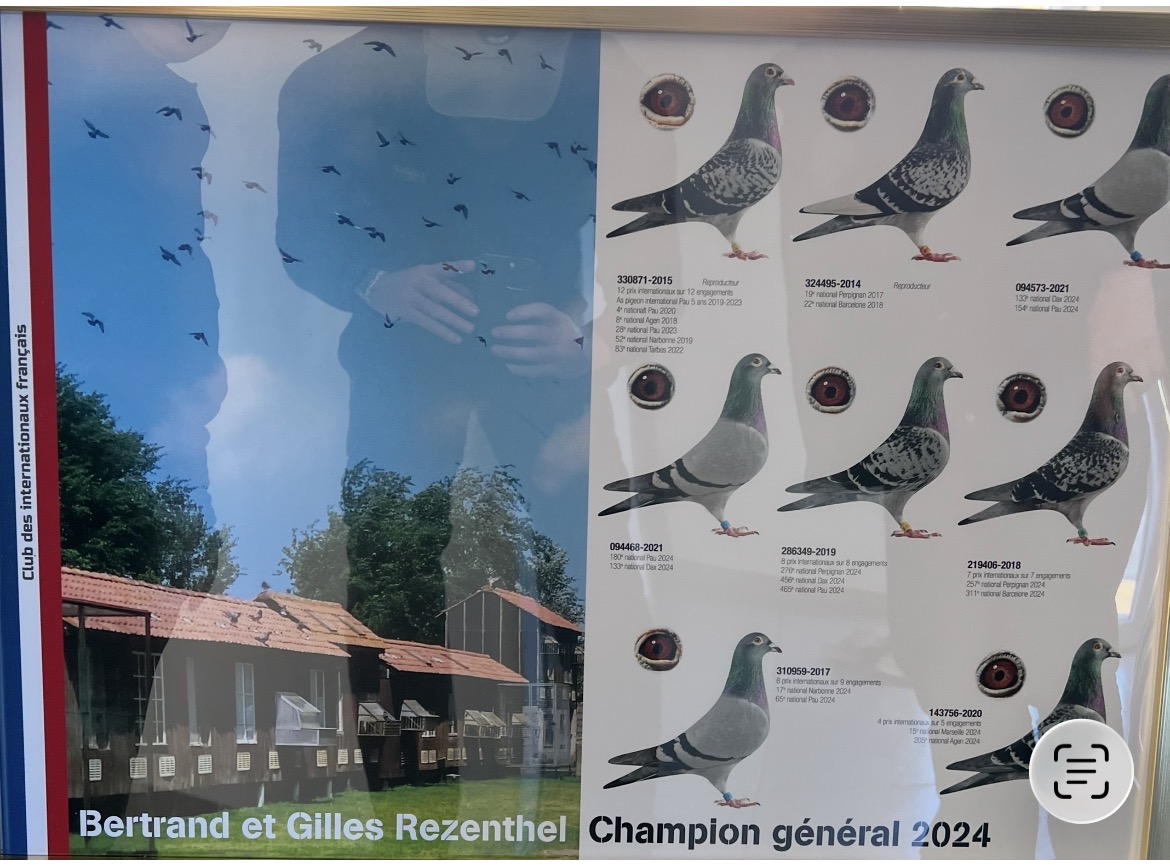
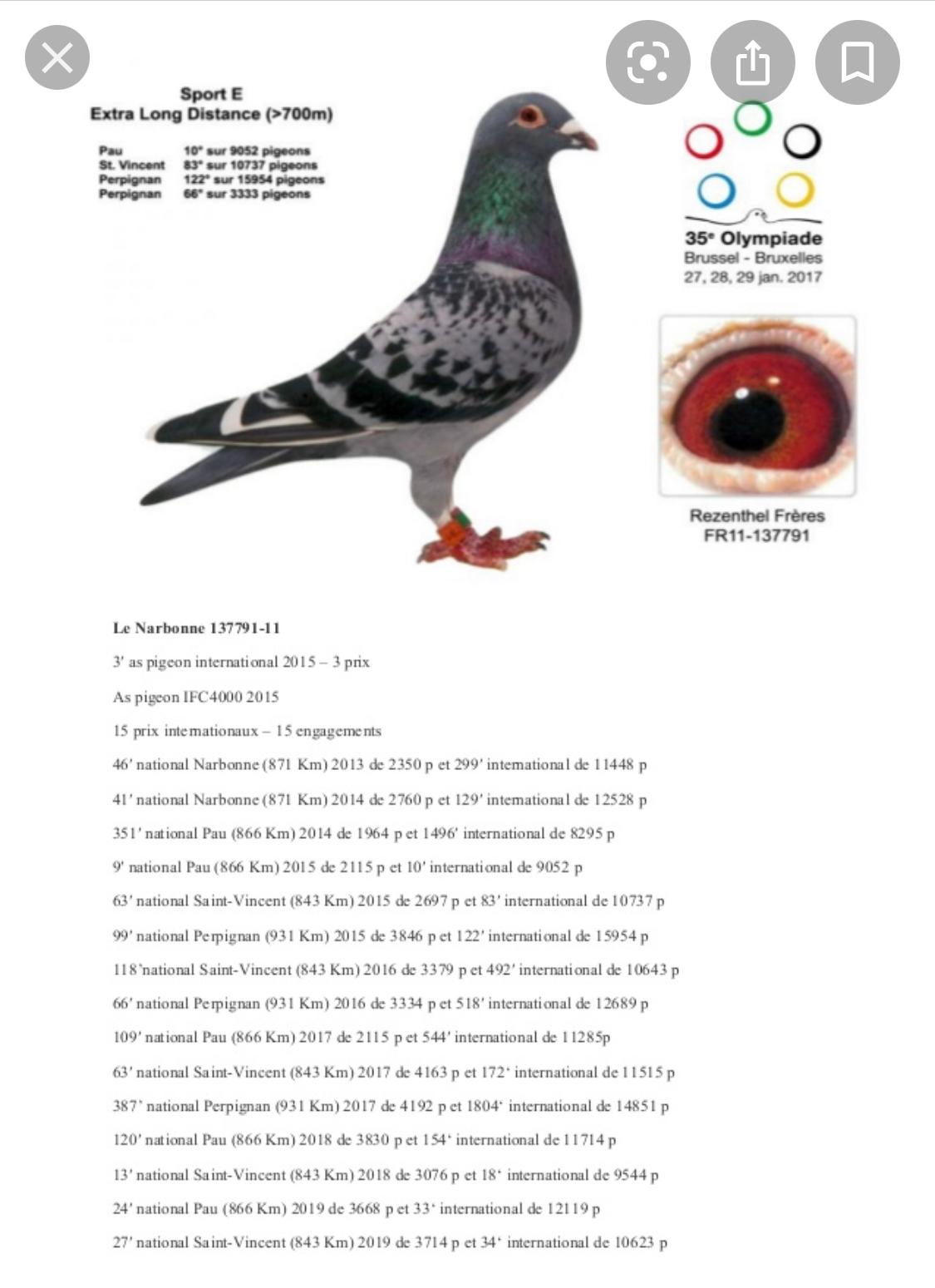

Representing Rezenthel Frères 2nd Europa Marathon 2025 – Alongside 1st Place Martha Van Geel – 3rd Place Rutz & Sons
This is where our experiment became particularly interesting.
We have been fortunate enough to race a small number of FR-ringed pigeons bred directly by Rezenthel Frères themselves.
We have enormous respect for this loft. Rezenthel Frères are, in our opinion, amongst the finest marathon lofts in Europe, with generations of top performances behind their pigeons.
And from the relatively small number bred by them that we have actually raced, some have developed into outstanding racing hens for us.
Their quality isn’t something we question.
Which is exactly why what happened next fascinated us.
Every Rezenthel-bred pigeon we tested showed AB or CT.
Without fail.
Our sample was obviously far too small to make any sweeping statement about the genetics of their entire family, and we would never pretend otherwise.
But amongst the pigeons we had physically in our loft and tested, the consistency was striking.
Here was a multiple Europamarathon-winning family, developed through generations of exceptional marathon performance, repeatedly showing the genetic combinations that were attracting so much attention.
Far from making us dismiss genetic testing, this was probably the part of our experiment that made us take it most seriously.
Perhaps we really were seeing the genetic fingerprints left by generations of selection for elite marathon performance.
The scientific literature gives some reason to remain interested too. Research has reported associations between particular LDHA and DRD4 variants and performance, while simultaneously warning that individual markers are insufficient to identify a top pigeon reliably.
But then we tried something else.
We brought those pigeons alongside our own families and formed pairings involving the favourable combinations.
We even had The 168 — already an exceptional breeder and herself carrying CT — to work with.
Yet the resulting offspring didn’t suddenly dominate our loft.
And that was the point at which our thinking began to change.
⸻
Maybe We Were Asking the Wrong Question
Our conclusion wasn’t that the Rezenthel pigeons couldn’t do our job.
Quite the opposite — pigeons bred directly by them have produced some outstanding performances for us in fact some of our best performance hens including 2nd National St.Vincent 2019, 8th National Barcelona 2022, 9th National Perpignan 2017,12th National St.Vincent 2017, 15th National Perpignan 2019 and 9th ACE pigeon Int UK 2020.
Nor were we suggesting that our Channel pigeons were somehow superior to Continental marathon pigeons.
That would completely miss the point.
The two jobs are simply different.
An extreme-distance pigeon racing across Continental Europe can face an extraordinary examination: enormous distance, heat, fatigue, difficult terrain, wind, navigation and many hours on the wing.
Nothing about that task should be underestimated.
But a pigeon racing into Britain can face many of those same demands before eventually encountering something else.
The sea.
And once that happens, simply comparing kilometres doesn’t necessarily compare the same race.
⸻
What Happens When You Add the Channel?
Imagine two pigeons racing 800 kilometres.
On paper, they’ve been asked to fly the same distance.
But one has a largely continuous land route towards home.
The other eventually reaches the coast.
Now it may have to make decisions that aren’t represented by the number 800km.
Does it leave the land?
Where does it cross?
Does it remain with pigeons travelling along the coastline or separate from them?
How do wind and visibility influence that decision?
What happens when there is no land immediately ahead?
And what combination of orientation, previous experience, behaviour, motivation and physical ability eventually produces the pigeon that commits towards home?
We don’t pretend to know all those answers.
And that’s really the point.
Neither did our DNA test.
The sea doesn’t make one pigeon better than another.
It simply changes the examination.
And perhaps generations of selection over two different types of marathon racing can emphasise somewhat different combinations of characteristics, even though there will obviously be enormous overlap between them.
That possibility became increasingly difficult for us to ignore.
⸻
The Genetics May Have Been Telling Us Something Real
This is why we wouldn’t write an article saying “LDHA and DRD4 don’t work.”
Our own findings are actually too interesting for such a simple conclusion.
Think about the contradictions we saw.
We had The 168, carrying CT, become one of the greatest breeding hens we have ever owned.
We had FR-ringed pigeons bred directly by one of Europe’s outstanding marathon lofts repeatedly showing AB or CT when we tested them.
Those same Rezenthel pigeons demonstrated their quality in our own hands, producing outstanding racing hens from a very small number tried.
Yet when we deliberately tried to put together the genetic combinations that looked strongest on paper, their offspring didn’t take over our loft.
And pigeons with apparently less fashionable genetic results could still beat them.
Now, years later, the pedigree behind the 2026 Belgian National Narbonne winner appears in front of us and there is the AA genotype staring back at us again.
Perhaps the most sensible conclusion is also the simplest:
The genetics may have been telling us something real. They simply weren’t telling us everything.
That is also broadly compatible with published research. The 2022 prospective study explicitly noted that top pigeons can possess genotypes outside the hypothesised optimum and concluded that a single genetic marker is insufficient to identify a top-performance pigeon.
⸻
Results and Pedigrees
After four years of experimenting, we eventually returned to something pigeon fanciers have been using for generations.
Results and pedigrees.
Not pedigrees simply filled with fashionable names.
Pedigrees backed by performance at the task we want the next generation to perform.
If we’re trying to breed pigeons to race the extreme distance into Britain, we want families that have repeatedly demonstrated the ability to do exactly that.
Parents.
Grandparents.
Brothers.
Sisters.
Half-brothers and half-sisters.
Generation after generation.
The more times a family successfully completes the same examination, the more confidence we have when breeding from it.
In a sense, those pedigrees are themselves records of genetic selection.
We simply can’t reduce that selection to two letters.
There are undoubtedly many genes involved in producing an exceptional racing pigeon, interacting with development, health, training, experience and environment. Even proponents of genetic testing increasingly describe these markers as one breeding tool rather than a replacement for performance selection.
And there will almost certainly be far more to learn.
⸻
Would We Test Again?
Absolutely.
That’s perhaps the surprising conclusion.
If someone produced convincing new research tomorrow involving large numbers of extreme-distance pigeons, we’d be fascinated to read it.
If technology eventually allows us to understand dozens or hundreds of genetic variants and how they interact, rather than looking at individual markers in isolation, the potential for pigeon breeding could be enormous.
Our experience hasn’t made us anti-genetics.
It has made us cautious about genetic shortcuts.
LDHA and DRD4 can give us information about a pigeon.
They cannot give us the complete pigeon.
And if another fancier conducts the same experiment and reaches a different conclusion, we’d genuinely be interested to hear it. Different families, environments and racing programmes may produce different observations.
We’re simply reporting what happened when we tested it, bred to it and then sent the offspring to the basket.
⸻
The Final Test
It is strange that after several years of hardly discussing the subject, two completely separate things brought us back to it within a fortnight.
A simple question from a friend:
“Do you believe in LDHA and DRD4?”
And then a National Narbonne pedigree carrying those familiar letters.
Looking back now, perhaps our answer to Iván should have been slightly longer.
Yes, we believe the genes are interesting.
Yes, some of the patterns we found were fascinating.
And yes, we believe genetics will have an increasingly important role in understanding the racing pigeon.
But four years of experimenting taught us not to confuse a favourable genetic marker with a guaranteed great pigeon.
The Rezenthel pigeons showed us that genetic patterns within an exceptional marathon family can be fascinating.
The 168 showed us that the complete breeding record of a pigeon can tell us far more than focusing on one part of its genotype.
And our breeding experiments showed us that putting favourable letters together on paper didn’t automatically produce the pigeons we needed.
So, for now, our greatest confidence still comes from generations of actual performance at the particular task we’re breeding pigeons to perform.
The DNA test can tell us which version of a gene a pigeon carries.
The pedigree tells us what its family has done.
The basket tells us what the individual can do.
And for us, the English Channel provides the final test.